Ealing Centre: Sep 2026 – June 2027
Foundation, Intermediate & Professional Certificate training
Students train to become Dalcroze practitioners and teachers in three stages. They work towards exams created by the Dalcroze Eurhythmics International Examination Board (DEIEB). The course lasts three years with an award at the end of each year (Year 1 – Foundation, Year 2 – Intermediate, Year 3 – Professional Certificate). The three years do not have to be consecutive. After receiving an award students can come back at a later date to complete their training. The Professional Certificate award enables the holder to call themselves a Dalcroze Eurhythmics teacher and they are able to teach children and adult beginners. Each Teacher Training course has a Director of Studies. The Director of Studies for Dalcroze UK is Dr Karin Greenhead
In Ealing, West London the course consists of 24 in-person weekly sessions and 15 two-hour online sessions. The sessions take place at St. Andrew’s Church Centre, Mount Park Road, Ealing, W5 2RS. The in-person classes are split between autumn, spring and summer. The 2.5 hour sessions consists of 90 minutes rhythmics and 1 hour of aural training, improvisation, creative movement or a seminar on the written work that is required by the award. In addition there are online classes making 60 hours of in-person training and 30 hours of online training.
The venue is close to Ealing Broadway station which is on the Central & District tube lines and the Elizabeth line. There is free parking on site.
The Centre Director and principle teacher for the Ealing Centre is Kaye Barker. Click here for her biography. https://dalcrozemoves.com/kayes-biography/

Venue: St. Andrew’s Church Centre, Ealing
Rhythmics
5.30 – 7.0 pm (Professional Certificate trainees only)
7.00 – 8:30 pm (Foundation & Intermediate & open to members of the public as Open Class sessions)
Aural training or Improvisation
6.0 – 7.0 pm (Foundation & Intermediate trainees only)
7.0 – 8.30 pm (Professional Certificate trainees only)
Autumn 2026: Sep 28th – Dec 7th (No lesson 26th Oct Half Term)
Online sessions : Oct 4th, 18th, Nov 1st, 15th, 29th, Dec 13th
Spring 2027: Jan 18th – March 15th (No lesson Feb 15th Half term)
Online sessions: Jan 24th, Feb 7th, 28th, March 14th, 21st
Summer 2027: April 19th, 26th, (May 3rd Bank Holiday), 10th, 17th, 24th, (May 31st Bank Holiday) June 7th
Online sessions: April 18th, May 9th, 23rd, June 6th
EXAM DATES – to be confirmed
If you are interested in signing up for either the Foundation, Intermediate or Professional Certificate Awards (2026 – 2027) then please contact Kaye at dalcrozemoves@gmail.com and/or Debbie Cartwright at admin@dalcroze.org.uk
The cost is circa £3,500 which includes participation in the Dalcroze UK Spring Course which is compulsory. It also includes membership of Dalcroze UK which gives students access to many hours of online training and discounts on other Dalcroze UK courses. Bursaries are available for teacher training courses.
Rhythmics for adults – Drop-in classes for those not wishing to train
The sessions last 90 minutes and the costs will be:
First session is FREE!
Further Drop-in sessions are bought in bundles either:
5 classes for £80 or 10 classes for £150
The classes can be taken on any of the designated Monday evenings you choose from September 2025 to June 2026. Unfortunately, no refunds can be given; however, you can defer using your bundle to the following year if unforeseen circumstances prevent you from attending.
To pay for a bundle please contact Debbie Cartwright at admin@dalcroze.org.uk
Foundation Teaching Training Course (a summary)
The course consists of training in the three main branches of Dalcroze Eurhythmics: Rhythmics, Aural Training and Improvisation but also includes a Written Work module, lessons in Plastique Animée and an introduction to the pedagogy of Dalcroze Eurhythmics. The following is a summary of the course content.
RHYTHMICS
Objectives: To experience music through the body and to understand musical elements through music-movement relationships. To learn to communicate and respond to others sensitively and to be creative in all aspects of the work.
CONTENT: Movement & technique: The course will develop and improve posture and balance. You will learn to control basic movements which involve extension and rotation and locomotor movements and actions at all speeds. You will explore body shapes, improve you coordination and develop your ability to express yourself through movement. At times you may learn movement sequences and many lessons will include the manipulation of objects (rhythmic balls, tennis balls, hoops, bean bags, tambours etc.) Lessons will include work as an individual, pair or larger group and will develop the ability to cooperate and work with others.
Exercises in metrics: Lessons will include the ability to accurately feel and respond to pulse and tempo, to respond to different metres (2/4, 3/4, 4/4, 5/4, 6/8) and the ability to conduct while stepping a range of rhythmic patterns. You will be required to do simple rhythmic dictations, to respond to instructions to step 2, 3 or 4 times faster or slower and to move in canon with music. Lessons will improve the perception of treble and bass and require students to show different durations in hands and feet.
Expression and Plastique: Students show phrasing, form and structure of music and are encouraged to express elements of music (dynamics, legato/staccato, accelerando/rallentando) through movement. In time students learn to express themselves in the medium and to show music through movement in Plastique Animée both as soloists and in groups.
EXAM CONTENT – summary
Follows: changing speed/ show rhythm patterns/ respond to signals and show relative tempi/ maintain a rhythmics ostinato
Meter: Identify and beat time to different time signatures (2/4, 3/4, 4/4, 5/4 & 6/8)/ beat time and step a range of rhythm patterns/ rhythmic dictation – write down a short rhythm after stepping it.
Rhythmic response & co-ordination: Show either a complementary rhythm or a rhythmic canon
Two-part: follow the treble and bass – 2 note values played simultaneously
Prepared: Phrasing – show the phrasing of a set piece of music/Group work – create rhythm piece showing structure, rhythm, independence of movement or rhythm.
AURAL TRAINING
Objectives: To develop aural abilities including inner hearing and memory. To develop the skill of perceiving and analysing intervals, triads and simple harmony. To learn to sight sing using Solfa (moveable doh) to learn to create coherent and shapely melodies.
CONTENT: Voice production, intonation and communication: Your tutor will teach good voice production and intonation, exercises in breath control, development of the vocal range and singing with another person. Lessons will explore songs in different tonalities and students will research their own songs.
Construction, recognition and sight singing: Students will learn to recognised intervals, the five pentatonic scales, the Ionian, Aeolian and Dorian modes as well as major and minor scales (up to two sharps or two flats) Classes develop confidence using solfa and the ability to sing back short melodies in solfa and to sight sing while beating time.
Improvisation: Students learn to improvise simple melodies while tapping a rhythmic ostinato and to create a melody from a given opening.
Chords, metrics & dictation: Students will learn to identify chords e.g. major key (I, ii, IV, V, vi) or I, III, iv/IV, v and vii in the Dorian or Aeolian mode) Students will be comfortable in the following metres (2/4, 3/4, 4/4, 5/4 and 6/8). The course includes melodic and chord dictations.
EXAM CONTENT- summary
Scales: Sing or identify doh or lah pentatonic, Ionian, Aeolian and Dorian modes from the tonic, Diatonic major scales up to 2 sharps and flats from C – C, Diatonic minor scales up to 2 flats and sharps, from the tonic
Intervals & triads: Recognise and construct intervals within an octave / recognise and construct major and minor triads
Sing Back: Sing a short melody back using solfa
Sight Singing: Sight sing a short melody using solfa
Sing a Song: Sing a song from six songs that have been sourced by the candidate
Dictations: Melodic dictation and a chordal dictation
Prepared: Continue a melody/ sing a melody over a rhythmic ostinato
IMPROVISATION
Objectives: To develop the ability to improvise vocally, on the piano and on the student’s primary instrument (if not piano). To build tonal vocabulary and the foundations for descriptive improvisation and for inciting a response in movement. To develop the memory and a sense of structure.
CONTENT: Instrumental & tonal exploration: Students will use vocal sounds as a basis of improvisation but will also explore the full tonal and dynamic range of the piano and their first instrument (if not piano). Improvisation will be taught using 5 finger position techniques and simple harmony using mainly primary chords.
Form & development of memory: Students will learn how to structure their music into simple forms such as ABA or Rondo form. They will learn how to improvise over a simple ostinato rhythm.
Styles, rhythmic vocabulary & tonal vocabulary: The course teaches students to play for natural movements, for example, jogging, skipping, walking or swaying. Students also create descriptive music using the tonality of modes, major and minor scales and cadences. The course includes improvising in a variety of metres (2/4, 3/4, 4/4, 5/4 & 6/8) and students work individually but also in duets.
EXAM CONTENT – summary
Prepared: Perform 3 tunes for natural movement (e.g. walk, jog, skip etc.)/ devise a short piece involving bruitage
Given one day in advance: Duet – improvise a duet using rules/Melody and accompaniment – Improvise a melody over a simple rhythmic ostinato or sing or play a given melody and create a suitable accompaniment
Given 30 minutes beforehand: rhythm pattern – create a melody using a rhythm pattern as a starting point, create a piece either showing an ABA form or a piece which changes metre/Cadences – continue a melody and complete it with a cadence
Descriptive piece: improvise a piece based on stimulus which could be an idea, picture object etc.
WRITTEN WORK
The Written Work component includes the following at Foundation level:
Descriptions of rhythmics, aural training and improvisation classes – 3 rhythmics classes, 1 aural training class and 1 improvisation class.
A portfolio of songs and music that can be used for natural movements
An essay which demonstrates a knowledge of the founder of Dalcroze, i.e. Émile Jaques-Dalcroze and its principles.

Featured Post
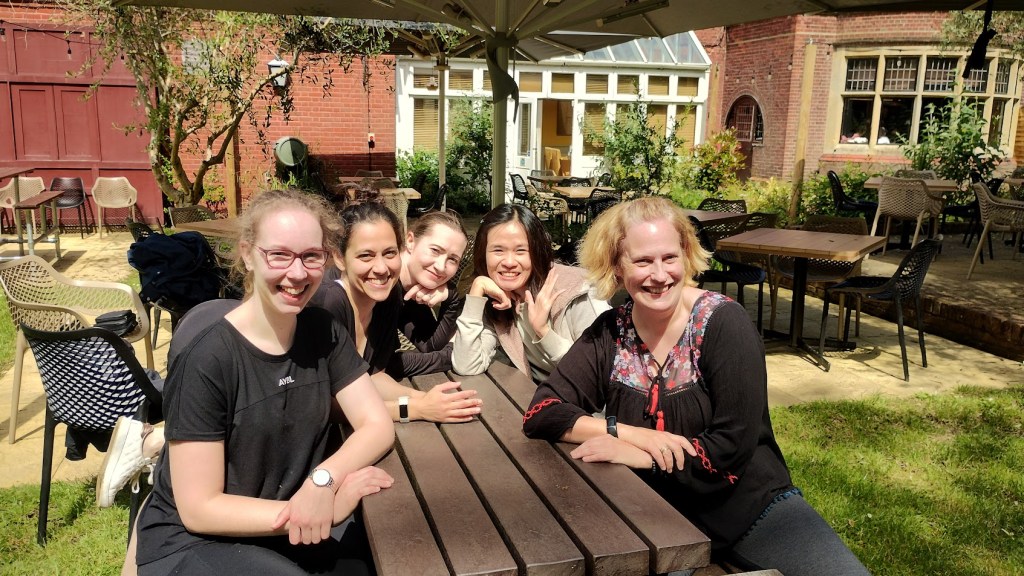
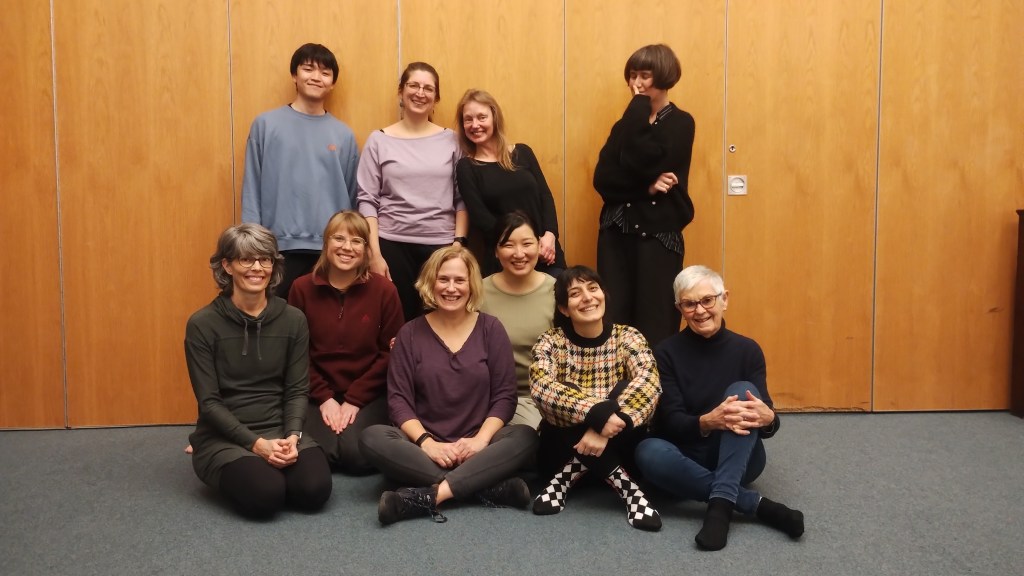
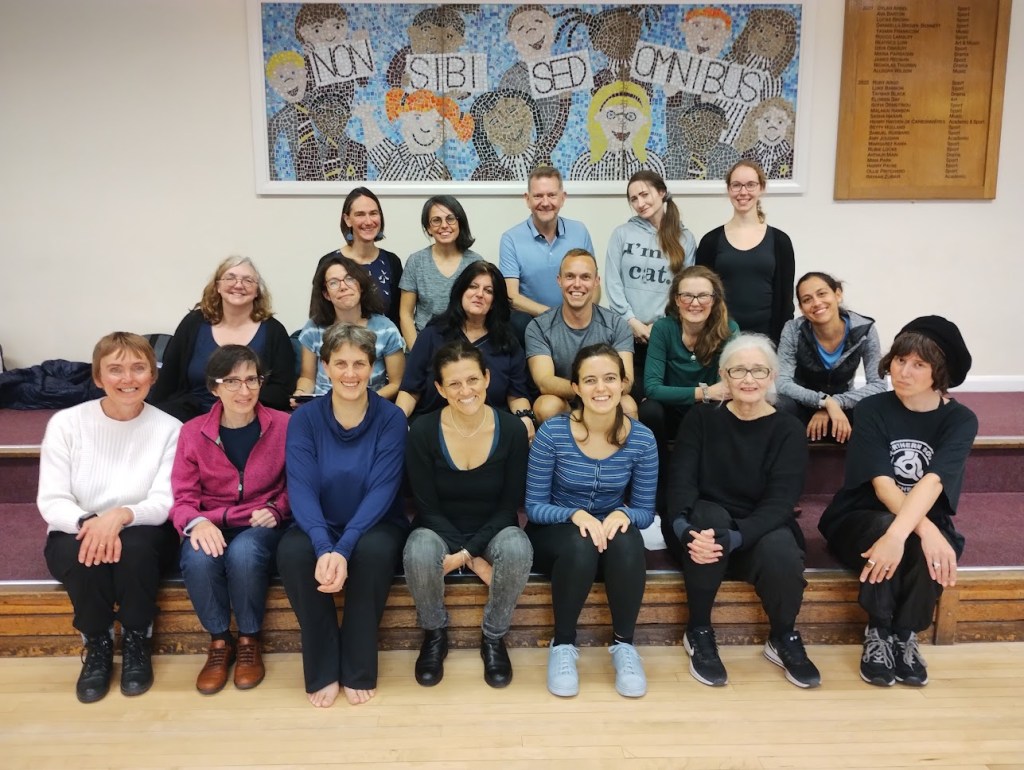
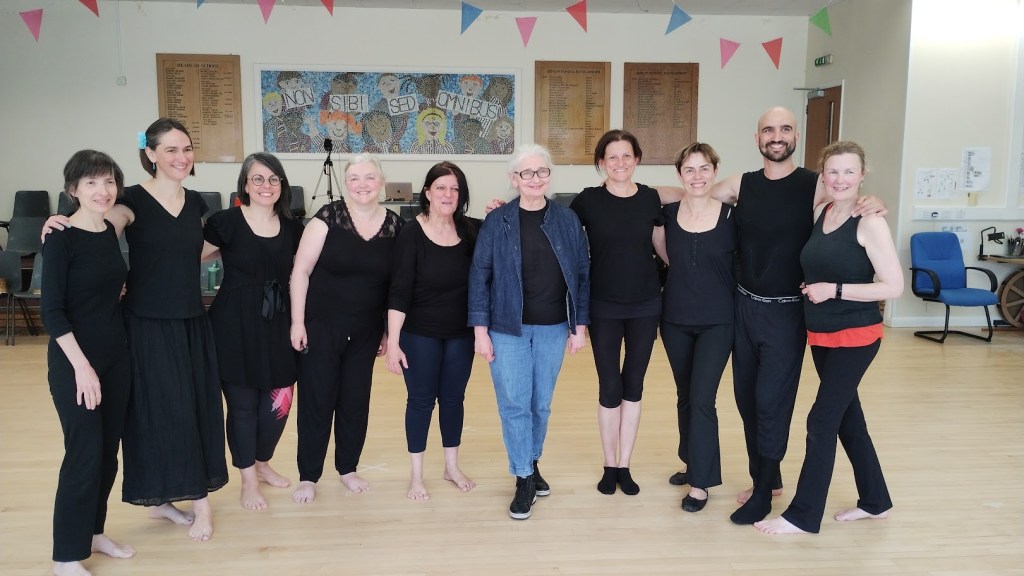
Foundation students 2022 – 2023 – Ealing Course with others who attended rhythmics classes only

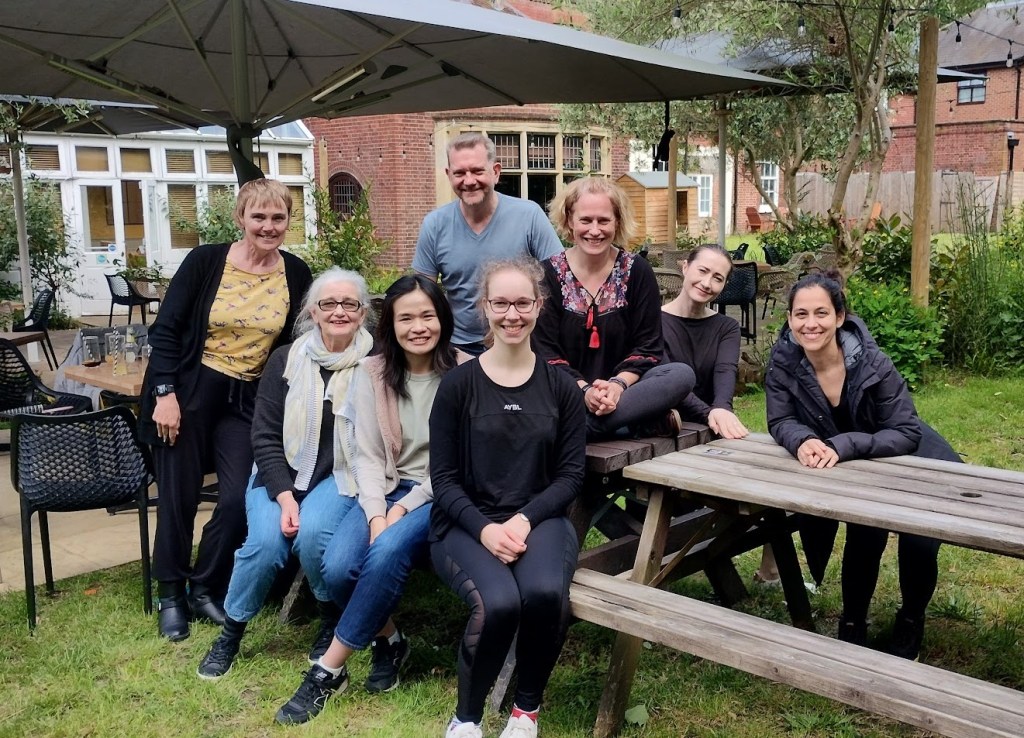
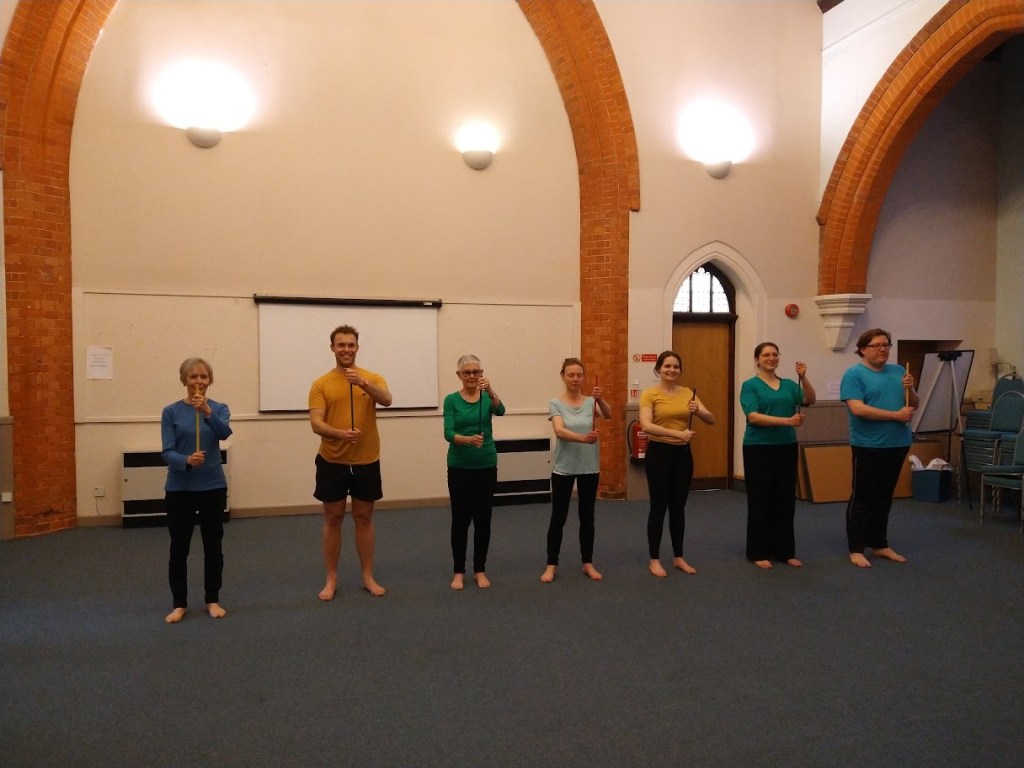
Foundation students 2022- 2023 & Kaye Barker (seated) – Croydon Course
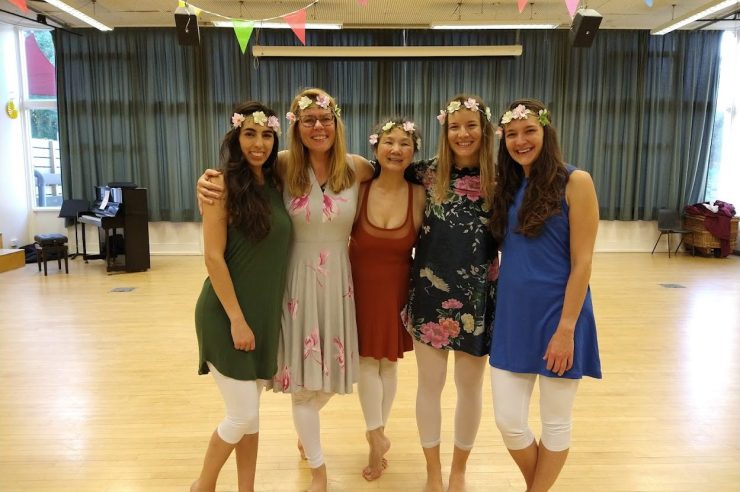

Teacher training
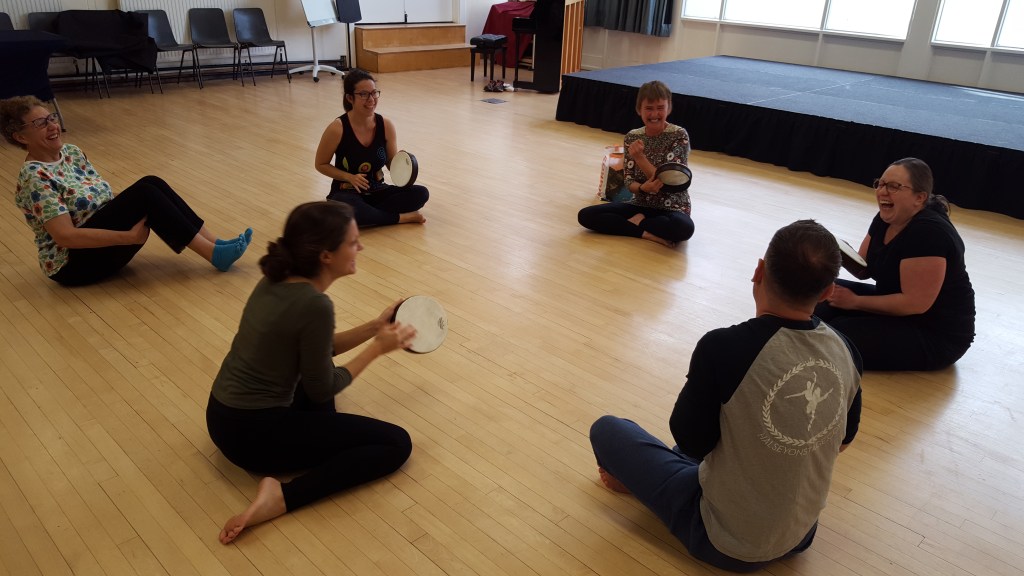
Teacher training in eight intensive weekends: Hatcham Free School, South East London, SE14 5SF
Sep 2024 – May 2025
Dalcroze UK offers training via eight intensive weekends, which take place at Hatcham Free School, in South East London. It is led by the Director of Studies, Karin Greenhead. Kaye is the lead tutor for the Intermediate students on this course and other tutors include Diplômés Andrew Davidson, Jacqueline Vann & Eugenia Arus.
If you are interested in signing up for the training from September 2025 then please contact either Kaye on dalcrozemoves@gmail.com or Debbie Cartwright at admin@dalcroze.org.uk Please note that if you wish to study for the Intermediate Award you are required to have passed the exams for the Foundation Award. Similarly, if you wish to register for the Professional Certificate Course you must have passed the exams for the Intermediate Award. In exceptional circumstances students may be accepted onto the Intermediate course without the Foundation Award.
Latest Posts
Follow Me
Get new content delivered directly to your inbox.
 Dalcroze Moves